Monday, May 14, 2012

Summer food at its best


April 21, 2012, DHNS:

Aside from just a plain, boring salad, I want to give guests the option of a lighter but filling main course this summer,” says Jaydeep Patil, senior kitchen executive at Le Jardin, The Oberoi. And in the blistering summer, this extensive seasonal menu is indeed a refreshing change. With appetisers, soups, entrées and desserts that serve as a great respite from the heat, the range of dishes has something for even those with specific culinary requirements.

Chef Patil says that rather than continually reinventing the same old dishes, he wanted to experiment with different techniques and garnishes to prepare the food. The inspiration to evolve the existing menu came from the seemingly obvious reason of using fresh, seasonal products. “I wanted to use fruits, vegetables and produce that are current and seasonal so that the food complemented the weather because the weather really determines what we eat and enjoy at various times of the year,” he notes.

Using exotic berries and fruits like raspberries, avocado and melon, the appetisers are a great way to start the meal. The choice includes a fabulous beetroot carpaccio with chevre, orange and berries. For those who are less adventurous, the chef also has proscuitto wrapped tenderloin that is lightly grilled and goes beautifully before either the cold gazpacho soup or the seafood and fennel broth. “I’ve tried to incorporate people’s favourites like prawn and tenderloin but treated them differently. Most of the meat on the menu is grilled or smoked and has a fruity flavour as opposed to the heavy, butter-based, rich texture of most winter dishes,” he adds.

In his introduction to the main course, Chef Patil emphasises that the seasoning of the meats is mostly made up of tangy lemon sauces with sides that are cooling and rejuvenating like celery, grapes and olives. And avoiding heavier meats like pork and lamb, the main course offers dishes like tuna with broccoli, rucola and California grapes and the great favourite and highly appetising roast chicken in herb sauce.

“I’ve retained traditional dishes like crepes and ravioli but with herbs and relishes like capers and sage that really add flavour to the dish making it subtly tasty and not overpowering or pungent,” he says.

The desserts make for a fine culinary experience. One can choose from either an unusual yet delightful pavé of Belgian chocolate and passion fruit or the very cooling and energising raspberry and chili sorbet.

From appetisers to desserts, Chef Jaydeep’s summer treats truly do leave you comfortably full while also helping you cope with the rising mercury levels.

Food-lovers can enjoy this summer menu till April 30.

Packed with a universal truth


April 21, 2012, DHNS:

A tale of displacement, adventure, conflict, disappointment yet hope. That was the essence of the play ‘Boy With a Suitcase”, by ‘Do I Know You?’, a collaborative theatre partnership between Ranga Shankara and Schnawwl-National Theatre, Germany.

The play opens with a fusion song in Hindi, Tamil, Kannada, Spanish, German and Russian, immediately signifying the global reach of the story to follow. Shrunga B V from Bangalore, plays 12-year-old Naz, upon whom adventure and unwanted circumstances are dumped. He is forced to leave his home and parents due to conflict, in search of a land that is ‘heaven on Earth and milk and honey’.

In this case, the destination was the aspirational London, where his sister lives. Naz, having being brought up on stories of Sindbad dutifully told by his mother, takes on the misfortune like his sailor hero would — as an adventure.  Director Andrea Gronemeyer from the Schnawwl-National Theatre says the aim was to show that Naz could be from a particular country, but his problems, are universal. “It’s more than just a story. It is reality. Children and adults alike can relate to the characters despite the difference in German and Indian culture.”

About the experience and response from the Indian audience, Andrea says that because of the better grasp of the English language, it is far more fun and fulfilling to perform in India. “The people here get the nuances and understand the illusions. Hearing them sigh and laugh at the exact moments we’d imagined only means that we’ve reached our goal of sensitising people with art.”

Although the play focuses on Naz, it is in fact a flashback that is being narrated by an older Naz, who has clearly escaped his earlier misfortunes. This older version, performed brilliantly by David Benito Garcia, holds the story together, shuttling the audience beautifully from past to present.

Another significant character is the vibrant Krezia, played by Lea Whitcher, another young refugee who befriends Naz on his ‘voyages’. The support caste included M D Pallavi, Nikolai Jegorow in varying roles as well as Coordt Linke and Konarak Reddy, who also provided live background music.

Fourteen-year-old Sakshi Sinha spoke for her brother, Sourav as well when she said that she was moved by the show. “It made me think of what I would do if I left home. I guess the point is that eventually no matter what your background, people all over the world struggle.” 

Be it border control guards or hungry wolves, Krizia and ‘Sindbad’ (as Naz introduces himself to the girl) overcome several hurdles, as they run towards the elusive land where troubles cease to be. And in an end that is hopeful but realistic, Naz does get to his sister, but finds the promised land “no different from home and is hell on Earth.”

Artistic Director, Arundhati Nag, says that the collaboration was a great step forward for theatre. “To see three years of hard work culminate in this magial show is very inspiring. The artistes are from six countries with only two whose prime language is English, which shows it’s not a mix but a true blend.”

Fresh take on humour


April 17 2012, Aakanksha Devi
Brilliant Act

Failure versus success. Studies versus sports. Big brother versus little one. And an audience, at the Chowdiah Memorial Hall, left rolling with laughter!

Such was the effect of the play ‘Big B’, co-directed and co-authored by Sayeed Alam and Niti Sayeed.

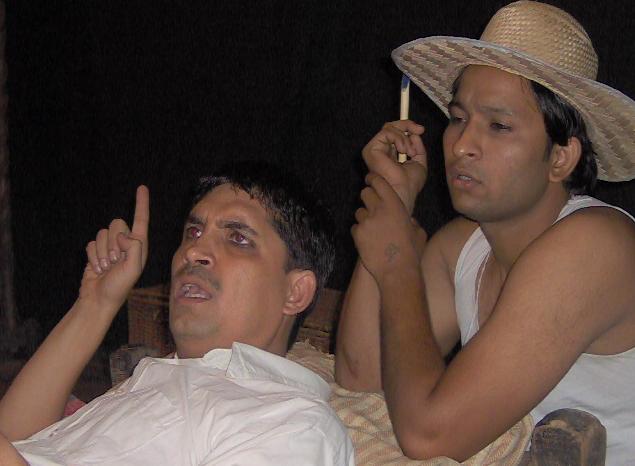
Brought to the City by the Bangalore Royals Round Table for the cause of ‘Freedom through Education’, this ‘IND-lish’ rendition of Munshi Premchand’s 1934 short story, Bade Bhai Saheb, ‘Big B’, took the audience back to the era of the ‘Raj’ to a hostel room of brothers Srikant and Samrat Prasad Pande. In line with the cause, the play tells tales of Srikant, played by Sayeed Alam, and Samrat, played by Ram Naresh, at school, satirically critiquing the education system.

Opposites in nature and aptitude, the brothers are constantly, though unwittingly, at loggerheads. The typical father figure to the intelligent Samrat but with no credibility, Srikant is an epitome of failure. Despite remaining in the ninth standard for five years, he dutifully admonishes his younger brother using broken English to literally translate his precious Hindi.

And while suffering seems to be Samrat’s birthright, he still looks up and even looks out for his brother by warning him from going out on dark evenings saying it was too ‘nighty’! Unwilling, however, to accept that he isn’t the ideal mentor, Srikant continues to give Samrat unsolicited advice causing the younger lad’s ‘head to eat circles!’ Or for current times, when Hindi is not frowned upon, “uska sar chakkar kha raha tha!”

This performance by Delhi’s Pierrot’s Troupe, used flashbacks by introducing a third character — a 90-year-old version of Samrat, played by Ekant Kaul. Sayeed says that the play has been done so many times, a fresh take was needed. “The charm of theatre is that it takes one back to the age of the characters. And the challenge is in performing something that is true to an era we haven’t seen.”

While the audience was in splits throughout, it was interesting to see that people empathised with the characters. Nikhil Y, who studied in boarding school, said that times indeed remained unchanged. “Some seniors were terrible at studies yet they insisted we study hard. This was lovely. It showcased the sheer genius of both Premchandji and the theatre company.”

By retaining the original period of the 1930s, the play interweaved past with present, celebrating greats like Gandhiji while ‘making jokes fly’ (mazak udana!) about Ashish Nehra.

Sayeed appreciatively said, “Performing in Bangalore is always spectacular. It’s so encouraging when people actually pay to watch shows.” The audience was also forthcoming in their praise. Theatreperson Arushi said that she was apprehensive of a ‘Hinglish’ play but found the show fabulous. “The performers were brilliant and the humour so excellent; it’s a refreshing change from the usual crappy comedy.”

Her husband Amitabh was also greatly impressed by the show. “It was nice, clean, simply and funny,” he says between laughs as he recalled dialogues.

A splendid show of culture


May 2, 2012, DHNS:
‘Swayam’

MVJ College of Engineering organised its much awaited inter-collegiate cultural
competition recently.

Aptly named Swayam – which means self, the fest followed the theme of
‘Incredible India’.

The event not only brought together students from different colleges from all over the State but also gave them an opportunity to showcase their talent in over 20 competitions that took place over the two days.

The students battled it out in various events including debate, music, dance and artistic and sporting events and it wasn’t only for the trophy or the cash prize
afterwards.

It was in essence for the pride of their alma mater!

 In keeping with the theme, the light music event, brought out the enviable cultural diversity of India as the contestants melodiously serenaded the audience and judges.

And the judges must surely have had a hard time deciding on the winner
but eventually, St John’s Medical College team was declared the winners.

One of the highlights of the fest, the ‘Battle of Bands’, saw ‘Band Hungry’ from SVIT walk away with the top prize.

But that hardly took away the talent or the brilliant performances by other bands. On a very different note, the debate battle drew a huge crowd as people poured in to hear the discussion — and a rather fierce one at that — about whether or not privatisation will lead to less corruption in India.

Though Nithin Yashes from SJMC was announced the winner, the arguments
of the other participants would certainly have given most politicians a good
run for their money.

Adding to the football frenzy in the City, MVJCE also came up with a novel game of football on water.

And after a whole lot of slipping, sliding, splashing and gliding, this unusual event saw a team from MVJCE, led by Vijay, emerge as the winners.

Meanwhile, in a far more graceful event, the dance troupe Pralaya from
BNMIT, made sure their routine was that much more refined as they claimed top spot in the Indian Dance Competition.

All through the two-day fest, the atmosphere was simply electrifying.

The auditoriums as well as the outdoor stages had audiences braving the sun and the occasional rain, to cheer on their college mates while the competitors took the stage, striving for perfection amidst worthy opponents.

There was not a hint of negative emotion in the entire place showing the true spirit and passion of a competition.

All one could hear was the ringing of college names and cheers for the performers.
It was commendable that even those who had lost still walked away with their heads held high.

The respect they gave to each other shone through the competitive spirit making it impressively noteworthy.

Swayam 2012 came to an end with a delightful performance by eminent singers of the Kannada film Industry.

Shamitha Malnad, Deepak Dodderi and Santosh Venky had the crowd on their feet, dancing and tapping to the popular Kolaveri Di and Chamak Challo — a fitting conclusion to the glorious fest.

What’s their age again?


May 4, 2012, DHNS: MATURE KIDS

With technology moving at a phenomenal speed, there is a new ‘toy’ out almost every other day to amuse oneself with.

This, though, seems to have brought about a huge change in children and teenagers of the modern day.

When previously, a 12-year-old could be seen playing merrily in a park, climbing trees, the modern day child is too busy playing games on a recently upgraded iPad.

And with content of all sorts freely available to these adolescents, it is hardly surprising that they appear far more precocious than ever before. Some parents are even happy to leave children to their gadgets and gizmos just to have them out of the way.

Siddarth J, father of a seven-year-old boy, says that if his son didn’t have the iPad to distract him, he would be uncontrollable. “When the family goes for an outing, the only way to keep my boy from creating havoc is by giving him the ‘pad’. He’s so engrossed in it that there’s thankfully no time for mischief,” he says.

Others, however, are appalled at the way teenagers find it essential to have the latest phones and gadgets as if they are a symbol of their status. So much so that if they don’t have anything flashy like an iPad or a smartphone to flaunt, they are ostracised.

Sapana Appaiah, a part-time wedding planner and full-time mother, says that she has to make a conscious effort to keep her children away from this new craze of technology.

“My daughter is one of the few kids in her school who doesn’t have a phone. If I were to give her one, she’d become obsessed like the others her age and soon become detached from reality. Eighty per cent of the children are out of control. I’d rather she had a few down-to-earth friends than several ‘wannabe’ types,” she says.

She does, however, mention that technology within limitations would possibly make youngsters more aware. “But it’ll have to be strictly controlled which I think it’s already too late for,” she adds.

But the issue goes deeper than just technology. According to child psychologist Sanjana Mudappa, this alarming change in children is also the result of almost blase parenting. “Parents think that giving in to their children’s whims makes them cool.

And the kids think by mimicking adults, they become adults,” she says. Under the wrong assumption that drinking, smoking and partying makes them adult-like, children do as they see their parents and older relatives do. That, according to Sanjana, is very harmful in shaping the personality of these children.

And in addition to being irrational and incorrect, it gives these youngsters a false sense of identity. “Teenagers and even younger children have grown up quicker than is necessary or even healthy. They have no sense of who they really are,” she says.

Reflecting a similar belief, Ivy D’Souza, a teacher at a well-known ICSE school in Malleswaram, says children are more and more confused these days due to the fact that with technology, they are living in an almost virtual world.

“These kids are losing about ten crucial years of their lives. It’s an unreal jump in mentality from 12 to 20. And unfortunately, I don’t see that changing for a long while — it may just get worse,” she laments.